Iranian meddling in Scottish elections; Facebook Oversight Board misses an opportunity
This week's latest in disinformation.

The Facebook Oversight Board ruled to uphold Facebook’s decision to ban President Donald Trump.
Amidst the January 6 insurrection on the U.S. Capitol Building, Facebook banned President Trump indefinitely on both Facebook and Instagram after he published a video address containing incendiary disinformation. Facebook later referred its decision of whether to maintain the ban to the newly christened Facebook Oversight Board, an independent Supreme Court-like body that interprets Facebook’s policies and rules on the “most difficult and significant” content moderation disputes. The move was lauded by some experts as the right way for the Board to begin imposing checks and balances on company moderation decisions.
However, their decision fell short of the hype. The Board simply volleyed it back to Facebook: while they agreed with the company’s decision to remove Trump, they took issue with them banning him for an indefinite amount of time. The Board gave Facebook six months to decide an appropriate length for the penalty and when/if Trump can ever return. This essentially puts the ball back in Facebook’s court to make a monumental, ideological decision about procedures on limiting political leaders’ online megaphones. Knowing Facebook, they will likely lean to the most politically and economically expedient option available to them at the time. Here, the Board missed an opportunity to exert meaningful oversight and precedent.
Hours after the decision, Trump railed against Big Tech on Wednesday, saying companies must “pay a political price” for boxing him out. Since January, Trump’s mentions on social media dropped 91 percent. While it is natural in any presidential transition for the spotlight to move on, this drop was due in large part to him being deplatformed from most social media outlets.
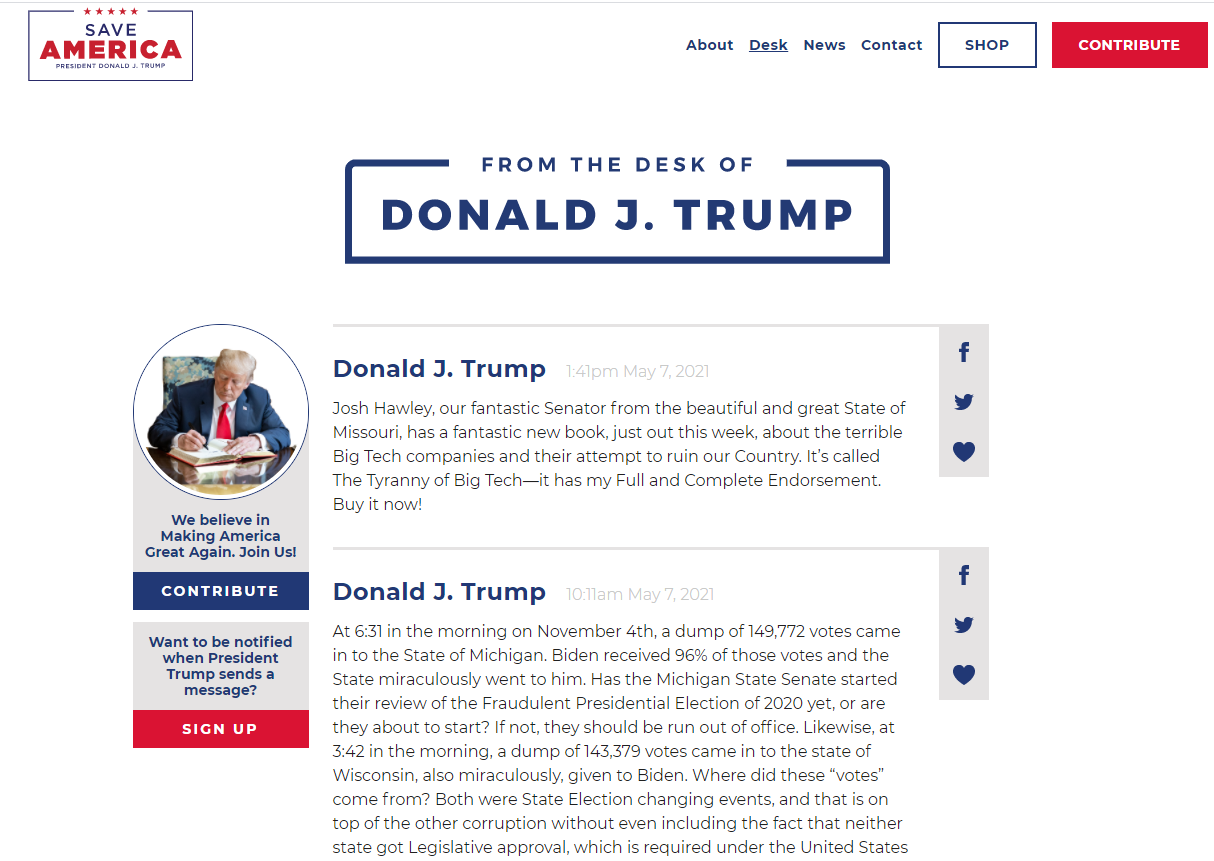
As a workaround way back into the Twitterverse and relevancy, Trump launched a new blog on Tuesday to get his message out, called “From the Desk of Donald J. Trump”.
Twitter, which also banned Trump, continued gatekeeping the former President from the platform by removing a Twitter account mimicking his blog, @DJTDesk, for tweeting out his blog posts. This effort to prevent him from circumventing the ban is in step with how Twitter and other social media platforms handle accounts that try to evade bans.
In the lead-up to a tight parliamentary election in Scotland this week, Iran is running an influence operation to interfere with the vote.
Iran’s activity intended to sew disunity and sway public opinion towards pursuing Scottish independence from Great Britain. The operation leveraged fake accounts on Twitter and Facebook to spread divisive messaging meant to influence voters.
The election is close and significant: if the Scottish National Party (SNP) wins a majority in the parliament, it is almost certain that they will vote for another independence referendum—the first since 2014.
Hong Kong activists anticipate that the government will propose a new ‘fake news’ law as part of an ongoing crackdown on free press.
Leadership in Hong Kong sympathetic to the Chinese government claim that the bill will address “misinformation, hatred, and lies”. However, it is more likely that the government is using the threat of disinformation to craft legislation that will police political opposition and dissenting opinions in media. We have seen this tactic play out in countries around the world in recent years:
Singapore’s government passed an ‘anti-fake news’ law in 2019, pitching it as means to limit the dissemination of false information online and a way to protect Singapore’s national security and democratic processes. However, it has instead been utilized as a pro-government spin tool by the dominant political party to police criticism and unfavorable coverage of their government from opposition parties, journalists, rights organizations, and individuals online.
A similar law in Hong Kong would contribute to a speech chilling effect in society and empower the government to quash criticism.
Other notable news bits:
DOJ will perform a four-month review of the department’s cyber defense strategy against ransomware and supply-chain attacks from foreign and domestic hackers.
Florida’s House and Senate passed a bill that disallows social media companies from banning politicians from platforms. Violations would result in $250,000 per day in fines for state-wide politicians, however social media companies still could impose two-week-long account suspensions and remove posts that violate their policies.
Far-right extremists are using more sophisticated methods to recruit new members, including distributing propaganda videos on gaming platforms and social media.
Senators Catherine Cortez Mastro (D-NV) and Rob Portman (R-OH) introduced a bill that would strengthen Congress’ ability to set standards around disruptive, new technologies to prevent China from dominating the standards-setting space. The bill would establish a task force to set forth a long-term plan for standards-setting for emerging technologies, like AI and 5G.